
In recent years, thermoforming has undergone a radical transformation thanks to digital technologies and Industry 4.0 integration. Traditionally used to make shaped plastic components from heated sheets, today this technique offers unprecedented precision, automation and quality control.
01
What is thermoforming?
It is a process consisting of:
- Heating a plastic sheet to its softening temperature;
- Shaping it with a mold, using vacuum (vacuum forming) or pressure (pressure forming);
- Cooling and trimming it to obtain the finished part.
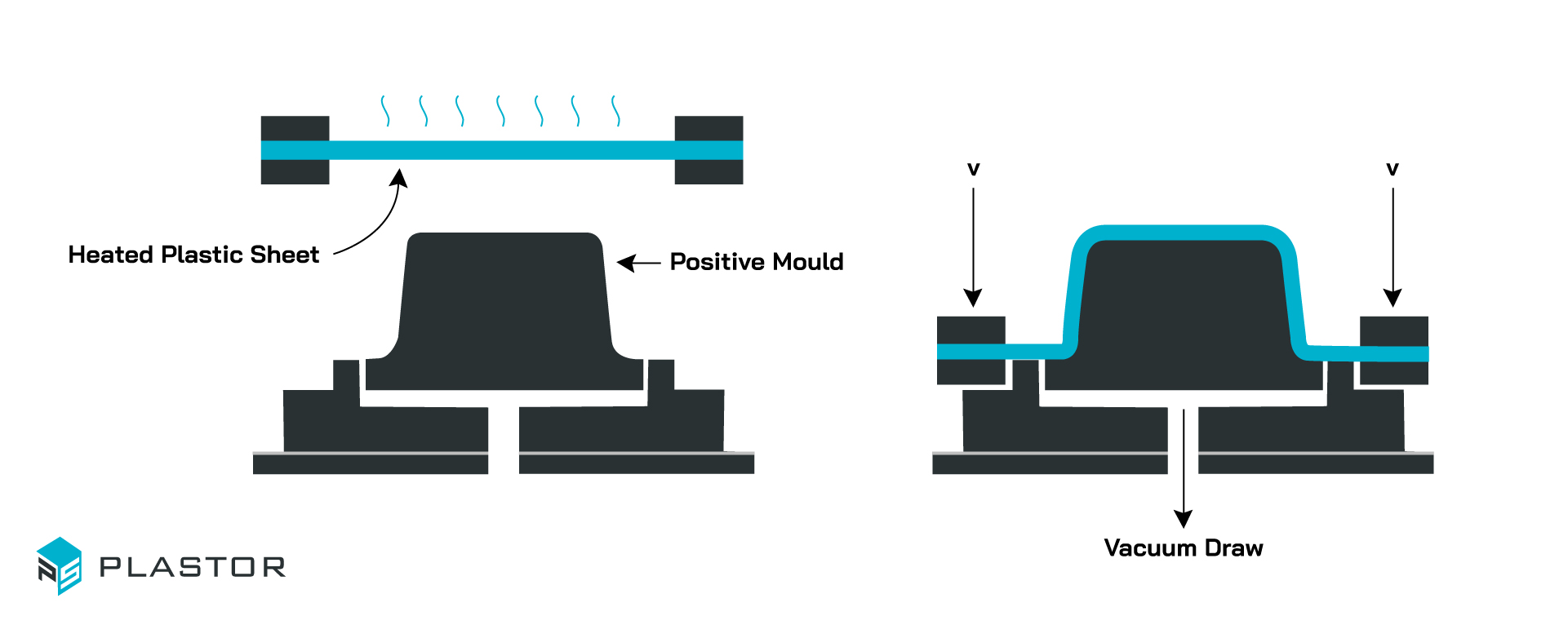
It is ideal for:
- Large, thin-walled components
- Simple or medium-complex geometries
- Medium-to-small batches with low mold costs
02
Innovations in Thermoforming 4.0
Innovations in Thermoforming 4.0
With the introduction of digital technologies, thermoforming has become:
- More precise: CAD/CAM systems and FEM simulations predict sheet behavior and optimize the mold before it is even manufactured.
- More repeatable: temperature, heating time, and cooling cycle parameters are precisely adjusted to a tenth of a degree.
- More efficient: the cutting, drilling, and finishing cycle is often directly integrated via CNC machines, eliminating manual steps and reducing the margin of error.
For example, at Plastor we use 5-axis CNC workstations to trim and finish thermoformed parts, achieving high-precision holes, slots, grooves, and other complex geometric details, ready for integration with other components.
03
A continuously growing sector
According to a Plastics News report, the global thermoforming market is growing at a 5% CAGR, with positive forecasts through 2030. The driving sectors are:
- Automotive: for interior panels, bezels, technical covers
- Medical: rigid blisters, sterile trays, and custom containers
- Logistics and industrial packaging: reusable thermoformed trays, dividers, containers
The introduction of thermoformable bioplastics, like PLA and recycled PET-G, is also boosting the industry, meeting circularity and sustainability demands.
04
The integrated process by Plastor
What Plastor offers
At Plastor, the thermoforming process is integrated with:
- In-house 3D CAD design and reverse engineering on samples
- Rapid mold production
- CNC numerical control cutting with micrometric precision
- Plasma treatments to improve adhesion and finishing
- Bonded or foamed assemblies, ready for final integration
This integrated chain delivers complex solutions with short lead times, from prototyping through to mass production.
05
Towards the future
Conclusion
Thermoforming 4.0 is no longer just a cost-effective way to make containers; today, it is an advanced technology for developing custom technical components with high performance and full compatibility with modern industry requirements. If you are looking for a partner to develop high-tech thermoformed components, Plastor is your ideal choice.