01
An invisible force
Plasma is often referred to as the fourth state of matter: an ionized gas made up of electrons, ions and other reactive species. It occurs naturally, for example, in lightning and the aurora borealis.
In industrial applications, plasma is generated and controlled to modify primarily the surface properties of polymers, without significantly affecting the characteristics of the material in its bulk.
At Plastor, we have developed patented automated systems that allow us to treat different types of polymers, with a particular focus on the plasma treatment of polyethylene powder.
02
Smarter surfaces
What happens when a polymer is treated with plasma?
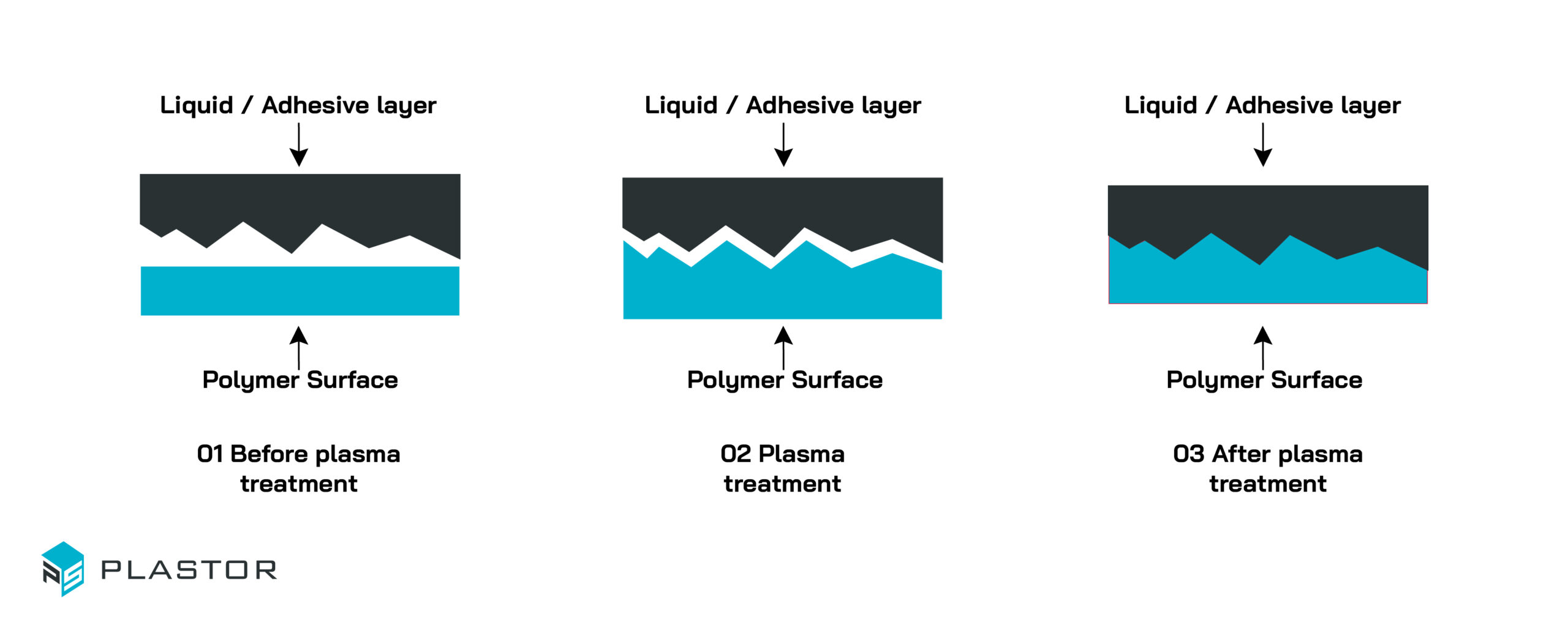
- Increased adhesion of paints, adhesives and inks
- Improved wettability, facilitating the application and adhesion of coatings
- Reduced surface contamination, including organic residues, oils and greases
The result is a surface that is easier to process and better suited to subsequent manufacturing steps, without the use of chemical solvents during the treatment.
The result is a surface that is easier to process and better suited to subsequent manufacturing steps, without the use of chemical solvents during the treatment.
03
Molecular cleaning
Plasma can also act as an “invisible cleaner”: the reactive species generated during the process interact with contaminants on the material’s surface, helping to remove or modify them.
This feature is particularly interesting when processingrecycled plastics, where the presence of contaminants and surface residues can make material management more challenging and affect subsequent processing steps.
04
Greener processing, Greater control
Plasma treatment represents an alternative to traditional chemical treatments in a wide range of applications. It can help reduce the use of solvents and water, while being easily integrated into automated and controlled production processes.
A benefit for the environment — and for manufacturing.
Furthermore, the use of low-temperature plasma under controlled atmospheric conditions makes it possible to treat materials while limiting thermal impact on the polymer and maintaining a high level of process control.
The ability to precisely manage and consistently reproduce treatment parameters helps achieve greater batch-to-batch uniformity, contributing to reduced waste and rework.
These characteristics also make plasma technology particularly interesting for applications in sectors with demanding process and quality requirements, such as food, biomedical and pharmaceutical packaging, depending on the specific application requirements and applicable certifications.
05
At Plastor, plasma treatment is already a reality
We have transformed plasma treatment into a reliable, scalable and repeatable industrial technology.
Thanks to our expertise and patented systems, we provide a solution designed to deliver enhanced performance, reduced chemical use and greater process control.
Plasma treatment can be applied across a wide range of industries:
- Automotive – for components such as dashboards, bumpers and interior panels
- Packaging – to improve bonding, adhesion and printability
- Renewable Energy – to promote adhesion in solar panel manufacturing processes
- Refrigeration – for bonding applications involving polyurethane and HDPE in insulated containers
Plasma does not change the nature of the plastic: it enhances its surface, making it better suited to the process that comes next.
And this is where technology, sustainability and performance come together.
Plastor: Enhanced Performance, Reduced Chemical Use.